



In February 2025, Google released a publication entitled Agents, followed in November 2025 by a further white paper entitled Introduction to Agents, and more recently followed up with the Agents Companion. One of the outcomes from this work is establishing a standard semantic convention for using agents, to ensure a common understanding for both human and machine activities.
The OpenTelemetry Group has picked up this work and incorporated elements of the guidance into its standardisation efforts. One of the outcomes is a model which describes agent frameworks, applications, AI models and tools. This is shown below.
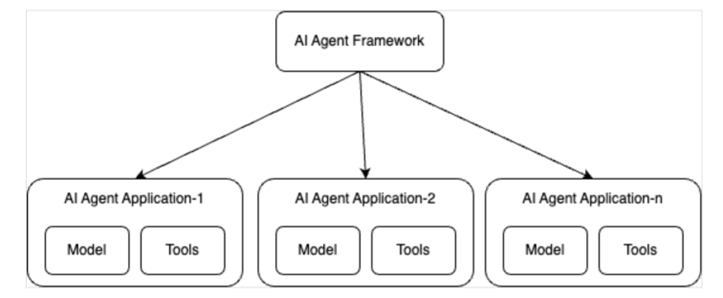
While this provides a useful approach to forming a common understanding of AI and its agentic evolution, the deployment of AI in an enterprise needs to be achieved through integration with existing architectural approaches based on the Zachman architectural model. In this model, a top contextual layer represents the business, while a second conceptual layer is used to show the architectural model of the business, enterprise wide. Below this, there are three layers which represent the increasingly more granular design activities at the logical, physical and component levels.
The final layer of the Zachman architecture is an operation layer representing the activities associated with running the components. However, in the SABSA framework this bottom layer is more usefully represented as a full 6×5 matrix in its own right, representing the activities required to support through life vitality of all five higher layers of the architecture.
The semantic convention above can be expanded and represented fully as a layered architecture to more rigorously describe Agentic AI and to provide insights into the Agentic AI governance model.
Frameworks are an architect’s artifact, and so the Agent Framework can be envisioned as a Conceptual layer.

Building an Agentic AI Architecture
The AI Agent Framework on its own does not show what is being modelled by the architect so a higher level architectural layer, the Contextual layer, is required.

These two layers form the Strategy & Planning life cycle phase of the Agentic AI Governance model.
The AI Agent applications can be shown as Logical layer constructs in the layer below this. Agent applications are often in themselves quite complex constructs known as System-of-Agent applications, within which there are multiple agents with their own specific tasks each of which may call one or more agents or tools.
To properly represent the architectural nature of AI Applications, the Physical layer of the architecture then represents individual AI Agents. To be consistent with standard enterprise architecture conventions, the models and tools shown in the semantic convention are shown as the Component layer of the architecture. These three layers provide the Design phase of the Agentic AI Governance model.
The full layered architecture is then shown as:
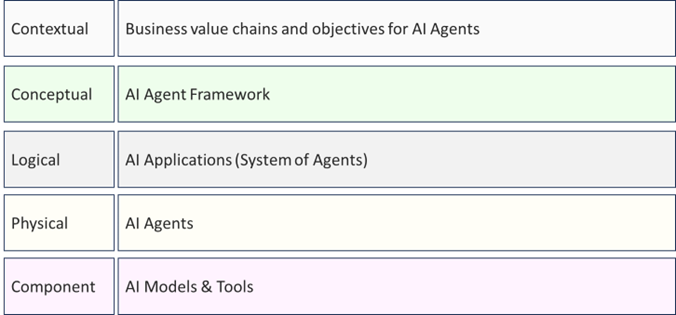
Echoing the SABSA approach, there is no requirement to separately define the Implementation phase of the lifecycle as this is well addressed already by the various project management methodologies. The final operation layer of the Agentic AI Architecture is shown as a full service management matrix with activities at all five layers, and forms the Manage & Measure life cycle phase of the Agentic AI Governance model.
Agentic AI Governance Model
With an architectural and service management matrix defined, the Agentic AI Governance model can be constructed as shown in the diagram below.

Conclusion
By projecting the semantic conventions of Agentic AI, a layered architecture can be easily developed, and by mapping this to the SABSA Governance Framework an Agentic AI Governance model emerges. This provides a solid architectural foundation for developing enterprise governance processes to achieve effective management across development, deployment, and operation of Agentic AI.