



Background
As far back as the 1990s businesses have been automating the processes of extracting data, filling out forms, moving files and so on using techniques such as screen scraping and automated workflows. UiPatch, Automation Anywhere and Blue Prism emerged in the early 2000s as leaders in business process automation. Blue Prism coined the term Robotic Process Automation (RPA) for their workflow automation technologies, and by 2012 it was a mainstream tool for digital transformation promising a “fully automated enterprise” and “empowering workers through automation”. An example of an advanced automation tool is n8n, popular with developers for creating elaborate workflows while maintaining control over their own data and logic, and with a vast number of integrations into business applications.
Automation requires custom development in order to deliver meaningful business value. It worked well for highly deterministic processes but was often unable to cope with less rigid and loosely defined processes and unstructured data. It was also vulnerable to missteps or failures when business activities changed.
AI has been promoted as a more flexible automation approach in which AI Agents can make planning decisions as well as using tools to automate tasks, and can learn on the job much as a human does. However, AI is a probabilistic solution based on highly processed training data. Whereas automation is a deterministic process which does as it’s told, AI has shown itself to be somewhat unpredictable, with a range of undesirable outcomes such as toxicity, hallucinations, and data breaches.
Architecting the Solution
Automation and agentic AI are not mutually exclusive approaches. The following table shows the characteristics to consider when deciding which to use.
Characteristics | Approach |
Structured Data | Automation |
Rule based workflows | Automation |
Prewdictive tasks | Agentic AI |
Interactions in natural language | Agentic AI |
Personalised responses | Agentic AI |
Regulatory compliance | Automation |
Adaptive tasks | Agentic AI |
Intelligent Automation
The boundary between automation and AI has blurred, and the new term Intelligent Automation (IA) is used to describe tooling which combines RPA with Artificial Intelligence (AI) and Machine Learning (ML) to provide an approach which can handle unstructured data, make decisions, and learn from experience. With many pre-packaged integrations and native AI capabilities, n8n enables processes to be built using the rigour of automation with the flexibility when needed to integrate agentic AI tasking.
Creating IA Process Maps
Both automation and AI workflows are associated with business processes. SABSA requires business processes to be described at the Contextual Layer, establishing a process mapping framework and security attributes at the Conceptual Layer, delivering process maps and services at the Logical Layer, and then describing the mechanisms and tools at the Physical and Component Layers respectively.
Process maps are created using process-oriented modelling techniques such as business process modelling notation (BPMN), UML-activity diagrams, event-driven process chains (EPC), and flowcharts. BPMN in particular has attracted considerable attention in the information systems research field as a convenient description technique to document and support re-engineering of business processes. It consists of flow objects such as events, activities, and gateways; connection objects showing sequence flow; swim lanes; and artefacts such as data objects.
In order to map business processes which are delivered using Intelligent Automation in our architecture, we can incorporate separate swim lanes for Automation and Agentic AI tasks, with Automation also providing a swim lane home for the MCP servers delivering Agentic AI tooling. These flows can be annotated with attributes to denote our security requirements. This then provides a powerful architectural tool for describing Intelligent Automation solutions within our security architecture. An example is shown below.
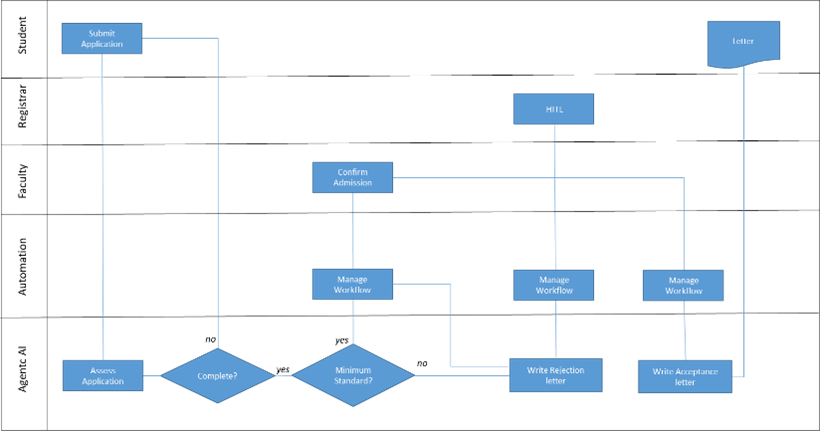
IA tooling can automate process mapping. Using swimlanes in n8n involves visually organising nodes (triggers, actions, logic) into distinct horizontal or vertical zones that represent different roles, teams, or systems. This approach bridges the gap between high-level business process mapping and the implementation of intelligent automation.
Conclusion
Process mapping is a significant part of the enterprise architecture, and this has become a more challenging requirement with the advent of Agentic AI. Nevertheless, by adopting an Intelligent Automation approach coupled with tooling such as n8n, we can deliver process maps which are themselves the mechanisms required to implement the architecture.
Co-authored by Enzo Peperkamp