



With yet another survey identifying abysmally low levels of success in achieving return on investment from AI projects1, the need for a credible business approach to securing the value promised by AI has never been more pressing. The solution has existed for decades – applying a disciplined enterprise architecture approach which provides a clear line of sight from components in the infrastructure through to business requirements. In other words, the Sherwood Applied Business Security Architecture, SABSA.
While the word security indicates SABSA is a defensive framework, it is, in fact, a much more relevant framework for AI. Security in SABSA-speak means achieving business success. Indeed, SABSA could have been called the Sherwood Applied Business Success Architecture, as that is exactly what it is. And for AI, with its billions of dollars of investment predicated on a successful outcome, SABSA is a critical component of any AI initiative.
Value in an enterprise setting is often discussed in the form of value chains, a concept introduced in 1985 by Michael Porter. A more recent approach was suggested by InfoTech Research Group2. This approach renames value chains as value streams and introduces the concept of value stages between the value stream and the business capability that delivers a component of the value chain or stream.
There are four key ways in which AI value can be achieved:
- Profit Generation. The obvious means of gaining value is to introduce an AI product or service that itself generates profit or adds to the profit of an existing product or service.
- Cost Reduction. Another obvious way of delivering value is to have AI solutions do the work of humans faster and/or at lower cost, achieving an overall reduction in cost within the value stream.
- Service Enhancement. Improving productivity and efficiency of existing services, as well as enhancing the service value to the customer, is another way in which AI can provide value in the value stream.
- Customer and Market Reach. Where AI solutions can enable greater reach to grow the customer base or market share is another way of adding value to the value stream.
Whatever the form of value that comes from AI, it needs to be articulated in a properly mapped set of value streams, value stages, and business capabilities. To support this, we need to develop a fully populated business capability map within our conceptual enterprise architecture, ensuring that capabilities are measurable when designed and measured when delivered. Promising value is important – demonstrating it has been delivered is crucial.
Another important contribution of the Info-Tech paper is the focus on ensuring that AI initiatives have executive stakeholder support. With the perceived, if not real, lack of success of many AI projects, support for AI initiatives is likely to be less forthcoming as time goes on. Having an understanding of how to engage effectively with key stakeholders will be an important skill for the AI community and its project managers. This provides a new tool for use by the Enterprise Architect, the Stakeholder MPSN model.
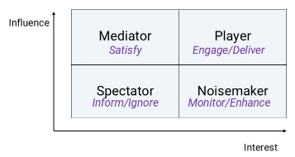
In this model, stakeholders are categorised according to the level of interest in the AI initiative and the extent to which they could influence the success of the project.
Those who have a high level of interest and influence are the stakeholders we will want to engage with. In particular, the business owner of the AI solution we are delivering will need to be a Player.
A Mediator is a stakeholder with a significant amount of influence, but who may not have a direct interest in the project. We will want to ensure that these stakeholders are satisfied that the project is proceeding well so as to retain their support and influence.
A stakeholder who has little influence and no interest in the initiative is one we will at best keep informed about the project, and more likely respect their level of interest and scope out of our stakeholder communications.
The Noisemaker is an interesting stakeholder. This person is one who has a lot to say but little influence. Obviously, if we have a detractor noisemaker, then we need to take action before the negativity spreads. Similarly, if we have a supporting noisemaker, then we may want to find ways to increase their influence to grow our level of real support. Either way, we must monitor them.
The level of interest taken by the various stakeholders will relate to the opportunities or threats that the AI initiative faces. A positive interest will provide an opportunity to further build support for the initiative, whereas a negative interest will detract from support for the initiative. Managing stakeholders is as much a part of project management as managing taskings.
1Atlassian: 96% of companies don’t see AI ROI, https://www.atlassian.com/blog/ai-collaboration-report-2025
2Info-Tech Research Group, Map Your Business Architecture